
What goes in, what comes out.
The specification first, in a table you can check. Then the same thing in the order it happens, including the limits, because a limit you know about is easier to work with than one you find at the end.
Specification
| Item | SnipHawk |
|---|---|
| Inputs | A video file you upload, or a YouTube link you paste |
| Source length | Up to 20 minutes on Free, 90 on Starter, 3 hours on Creator, 4 hours on Pro |
| What comes back | A ranked shortlist of up to 15 clips, each with a score, a label, three titles and a written reason |
| Transcript | Word-level across the whole recording, editable before export |
| Framing | Smart Fill, Fit Blur, Fit, Center Crop, split-screen for two-person recordings |
| Ratios | 9:16, 1:1 and 16:9 from the same project |
| Captions | Timed from the transcript, styled per clip, burned into the export |
| Export | One MP4 per clip, 720p on Free, up to 1080p on paid plans |
| Storage | 1 GB on Free, 15 GB on Starter, 50 GB on Creator, 100 GB on Pro |
| Retention | Working copies of the source for 1 to 60 days depending on plan; exported clips for 7 days to a year |
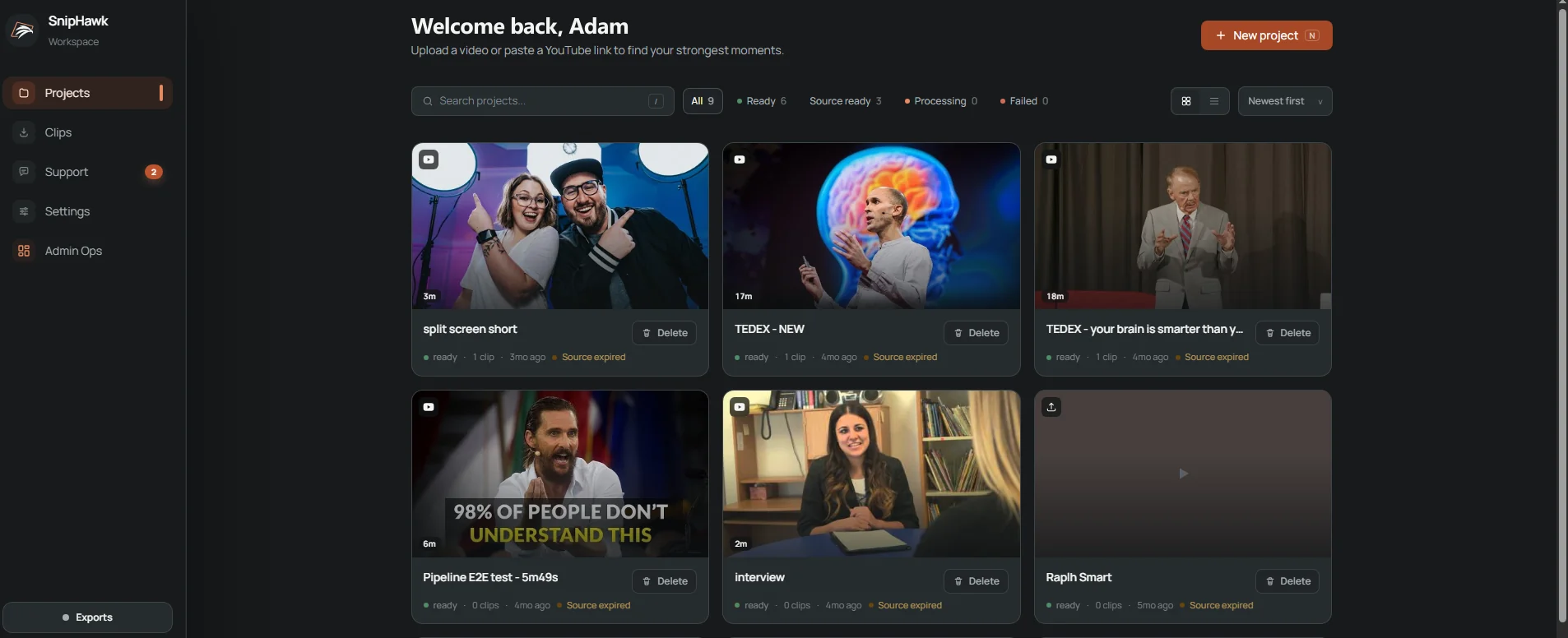
1. Import
Upload the file, or paste a YouTube link. There is no re-export on your side and no proxy file to build first: the recording goes in as it came out of the camera, the call or the stream.
Either route creates a project you can name, come back to, and delete yourself. The project carries the source, the transcript, the shortlist and every export made from it.
2. Transcribe
The whole recording is transcribed word by word before anything is scored. That order is deliberate. The transcript is what makes a suggestion quotable, what gives captions their timing, and what stops a clip being assembled from a guess about what sounded interesting.
3. Rank
Candidate moments are lifted from the transcript and scored one at a time, then sorted by strength. The list is cut at the fifteen strongest. Each one arrives as a real time range with three suggested titles and a sentence describing what it has going for it.
Fifteen is the ceiling on a project, not a target. A short recording returns fewer suggestions, because fewer of its moments stand up on their own.
4. Review
Opening a suggestion shows the clip the way a viewer will see it, not a strip of source video you have to imagine vertically. You can move the in and out points if the cut landed late, change the framing, change the caption style, and swap the title for one of the three on offer.
Nothing is committed until you export. Rejecting a suggestion uses nothing up.
5. Export
One MP4 per clip with the captions burned in, named by project and clip so the file makes sense on disk. The same clip can be exported again at another ratio or framing without processing the recording a second time, and each export is kept as a version in the clip library.
Limits
These are real limits, not marketing hedges. They are on this page so that they can be planned around.
- Suggestions are ranges, never writing. Everything ranked comes from words you actually said. The software does not draft lines, paraphrase, or stitch two unrelated passages together.
- No publishing. SnipHawk stops at the file. Accounts, scheduling and posting stay where they already are.
- Sources expire. Working copies are deleted after the plan's window — a day on Free, up to 60 days on Pro. Exports have their own, longer window and are never deleted with the source.
- One project, one recording. A project is built around a single source. Compilations across several recordings are made in an editor, not here.
- No performance claim. SnipHawk cannot tell you what a clip will do with an audience. It can tell you the search is done.
Plans
SnipHawk is priced by the minutes of source you process and the clips you export, not by seats. Prices, limits and what each plan includes are on the plan screen inside the app, before anything is charged, so the number you agree to is the number on the invoice. There are also top-up packs for the month a plan runs out early; each one lasts 90 days from purchase.
Next
Access is opened by hand, in batches. Ask for an account and you will get a reply from a person, or read what SnipHawk is for and who it is built around.
Put a recording in. Read the list.
Access is opened by hand, a few accounts at a time. No card.
Request access